





Nothing builds appreciation for sleep quite like a life-long sleep disorder… or so I thought until my bed frame spontaneously reconfigured itself into what we up here in Canada like to call “a death trap”1. It turns out beds have a tremendous impact on the quality of sleep. Who knew?2
Science fiction and fantasy authors have long been aware of sleep’s potential where plots are concerned—not simply as a means of transporting people from one era to another, as useful as that is. Sleep can figure in so many ways, as these books demonstrate.
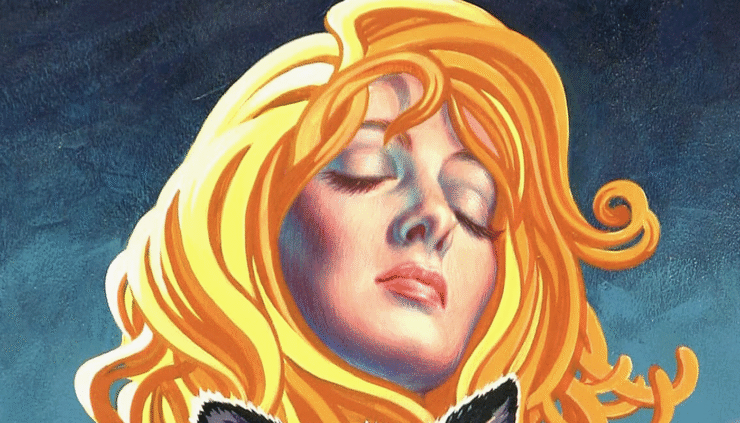
Sleepwalker’s World by Gordon R. Dickson (1971)
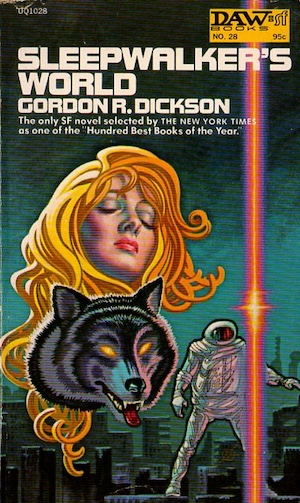
Core Taps combined with broadcast power solved the terrestrial energy crisis3. No person on Earth needs ever lack for energy again. True, broadcast power came with an unforeseen complication—most humans within range of it fall into a deep sleep—but it is a small price to pay for prosperity.
Rafe Harald, one of the few immune to the induced slumber, returns from the Moon to discover that his friend Ab Leesing is missing. Rafe sets out to find Ab. What he finds are secrets… and a monster.
Traditionally, every SF author is allowed one impossible assumption. In this case, it is that humans would be so desperate for energy that they would completely ignore their chosen energy generation system’s appalling externality. Obviously, a straightforward cost-benefit analysis would compel the adoption of alternative systems.
Lincoln’s Dreams by Connie Willis (1987)
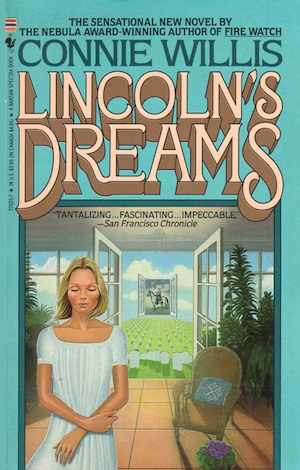
Richard is convinced that his girlfriend Annie’s vivid Civil War dreams are a symptom to be cured. Annie wonders if the dreams have some deeper significance. As the dreams involve the American Civil War, Annie appeals to Richard’s old college roommate, who is researching that period, for help. Do her dreams reflect reality, or are they simply fantasies from her subconscious?
Jeff, the historical researcher, establishes that the dreams do indeed seem to originate from an American Civil War figure… although not Abraham Lincoln, but Robert E. Lee. However, unless Jeff can work out why Annie is being singled out for these dreams, Annie may well be doomed.
One of the many questions for which professional historical researcher Jeff appears to lack answers is how it was two stalwarts like Lincoln and Lee ended up on opposite sides of a seeming causeless conflict.
On an unrelated note, the following words do not appear in this American Civil War-centered novel: “slave,” “slavery,” “black” (save as a color of blisters, objects, and animals), African (save in reference to violets), “Negro,” or “abolition.”
Harriet the Invincible by Ursula Vernon (2015)
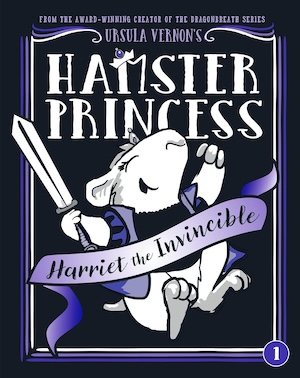
Princess Harriet receives delightful news on her tenth birthday. The wicked fairy Nightshade had cursed Harriet. When Harriet turns twelve, she will prick her finger and fall into a deep, magical sleep. So it is written. So shall it be.
Harriet reasons that she can only suffer her doom if she is still alive at twelve. Therefore, the curse will protect her until then… and therefore, Harriet is functionally indestructible. There is no reason why Harriet cannot spend the next two years vanquishing evil. When her curse does arrive? Well, by that time Harriet will be an experienced adventurer. Who knows what could happen?
There is a lot of ground between “must be alive, and retain sufficient cognitive ability that sleep and wake can be distinguished” and “invincible.” Horribly injured people can sleep. Badly brain-damaged people can sleep. Luckily for Harriet, this novel appeared under the author’s Ursula Vernon byline and not her T. Kingfisher horror-oriented persona, or Harriet’s fate might have been much darker.
Insomniacs After School by Makoto Ojiro (2019–2023)
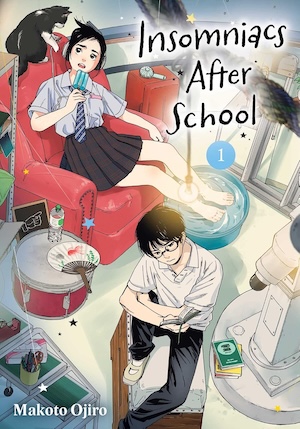
Grumpy highschooler Ganta Nakami cannot sleep because pessimistic Ganta believes the future can hold only increasing disappointment. Cheerful highschooler Isaki Magari cannot sleep because her potentially fatal heart condition means she might never wake up. Insomnia seems inescapable.
Salvation comes in the form of their school’s abandoned astronomy club observatory. Both Ganta and Isaki have no problem sleeping there. However, access to the observatory is contingent on there being an astronomy club. It’s up to Ganta and Isaki to bring the club back from the dead.
This romance manga is far more upbeat than “two teens united by paralysing existential dread” would suggest4. It’s also almost entirely mundane, except for one detail. School legend has it that a heartbroken schoolgirl cursed the observatory. However, this is a barefaced lie put about by Isaki, who does not want other people to intrude into her refuge.
The Sleepless by Jen Williams (2025)
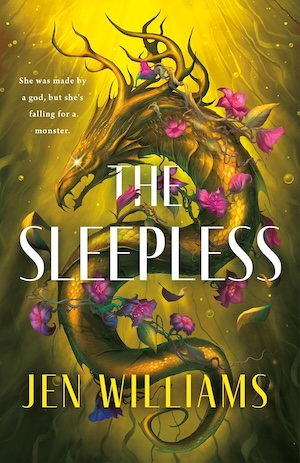
Artair is one of the Sleepless. Not in the sense that Artair cannot sleep. Rather, Artair needs to be careful when he sleeps. Artair shares his body with monstrous Lucian. Whenever Artair sleeps, Lucian is free to run riot. This is why the Brothers and Sisters of Perpetual Morning restrain Sleepless like Artair while he sleeps.
Mother Maura of the Bloody Claw blackmails Artair into running a little errand for her. Artair must kidnap a keltraxia cub from the Jih forest, and deliver it to Mother Maura. Why does Mother Maura not do this herself? In part, because the Jih forest has guardians. One such, Elver, wastes no time in confronting Artair… and teaming up with him.
Readers should be aware that this is part one of a duology, which is to say it introduces the setting, asks existential questions, increases the stakes and leaves matters such that you will want to buy the second book. Readers will also want to know that second book, The Dreamless, was published in May 2026.
Obviously, there are far more than five novels driven by sleep or its lack. There could six or seven, and I’ve even heard tell that numbers go up as high as eight. I may have overlooked, forgotten, or deliberately snubbed your favourites. If so, please mention them in the comments.
- The frame has three lengthwise supports. The one in the middle is quite solid. It turns out Ikea in its wisdom provided long screws for the two side runners but positioned the rail screw hole such that only the last millimetre of screw engages. This means the two on either side will fail and when they do, the mattress will suddenly tilt to one side and roll the occupant out of bed. The frame could still be used as long as I, a bad sleeper who thrashes continually, remain perfectly still over the center rail. Nevertheless, I am getting a new frame… and not from Ikea. ↩︎
- Aside from judgemental legume-conscious princesses, I mean. ↩︎
- I ran the numbers for geothermal energy and I’m not sure it is quite as useful as Dickson needs it to be. ↩︎
- At least as of volume 10. If the final volume pulls an Anders Loves Maria, I will be so mad. ↩︎


The Lathe of Heaven, Ursula K. Le Guin, 1971. Need I say more?
I can highly recommend Charlie Huston’s “Sleepless”.
Nancy Kress. Beggars in Spain.
Lawrence Block’s Tanner series. Sixties spy and heist spoofs; if you like Westlake’s Dortmunder, you’ll most likely like Tanner. Evan Tanner’s sleep center was destroyed by shrapnel in one of the US’s anti-communist wars, and he uses the extra hours in a day to amuse himself supporting as wide a variety as possible of hopeless revolutionary movements, like putting the Stuart pretender on the throne of the UK.
I am surprised you did not mention the Sleepless series by Nancy Kress.
In at least some versions, Kal-El (and presumably Kara) does not sleep. So don’t the Jem’Hadar in Star Trek.
In Sturgeon’s “Microcosmic God,” the protagonist (if that is what he is) is said, in passing, to have invented a drug that makes sleep unnecessary.
Moe from the Simpsons claims that he has never slept a day in his life.
Jonas, in The Claw of the Conciliator, apparently does not sleep. He is also apparently an android, so that may explain it.
Both Gully Foyle (The Stars My Destination/Tiger, Tiger) and Molly Millions (Necromancer) have undergone procedures that enable them to go for very long periods without sleep under certain circumstances.
Finally, and lest we forget, Fred from Once Upon a Mattress; Sleepy from the Disney animated Snow White and the Seven Dwarfs (there is no other Disney version), and, well, Sleeping Beauty.
This past year’s series in Japan’s Kamen Rider franchise, Kamen Rider Zeztz (the first KR series to be streamed internationally on YouTube), is built around the hero battling monsters in the dream realm (the name is a play on “ZZZ”) that seek to make nightmares come true in the real world. The Riders are trained in lucid dreaming, and Baku/Zeztz has a knack for falling asleep at will in order to enter the dream world. One character, known only as “The Lady,” is a fugitive from the intelligence organization behind the Rider system, and it’s established that she’s gone without sleep for something like 17 years so that they can’t get to her in her dreams — although it’s never explained how she pulls off such a trick, which should be physiologically impossible and would have become psychologically debilitating in a relatively short time.
A novel about the [US] American Civil War which doesn’t mention slavery, enslavement, people of African ancestry? One does wonder about the extremity of political denialism or historical ignorance possible to not mention any of these things once.
Wasn’t sleeplessness the entire basis of the plot of Nancy Kress’ Beggars in Spain? (Which I’ve not read).
Denial of the racist foundations of the Civil War has been a running thread in American culture almost since before the ink dried on the surrender treaty. See here:
https://en.wikipedia.org/wiki/Lost_Cause_of_the_Confederacy
It’s denialism and ignorance, yes, but it’s hardly limited to that one book. For most of the 20th century, it was more the norm than the exception — see Birth of a Nation, Gone with the Wind, Song of the South, etc. Edgar Rice Burroughs’s heroic John Carter was a former Confederate soldier. There’s a Republic Zorro serial whose protagonist is a post-Civil War descendant of Zorro, and the opening narration pointedly avoids establishing which side he fought for in the war. There was a pervasive tendency to either sanitize slavery or avoid acknowledging it altogether, and to treat the war as just a national madness where brother turned on brother for no good reason, or at most to treat the Confederacy’s goal as the defense of states’ rights and Southern culture.
When I was in grade school, in the 70’s, we were taught about “The War For Southern Independence”. Yeah…
It is amazing to watch the contortions some media of the mid-20th century will go to to try and appease “both sides” of the Mason-Dixon Line. There’s an episode of the James Garner western “Maverick” that states that card sharp Bret Maverick and his brother, Bart (played by the great Jack Kelly) both fought for the Confederacy until they were captured – at which point they fought for the Union out West as “Indian fighters” (which is its own issue). The so-called “land of the free” continues to struggle to acknowledge its original sin of slavery. Until 2016, I operated under the mistaken impression that things were getting better in that regard.
And then there are things like The Dukes of Hazzard that use the Confederate battle flag as just a symbol of “Southern pride” and are either innocently unaware of or disingenuously in denial of the fact that the battle flag, having been abandoned after the war, was only repopularized in the 1960s by racist groups that adopted it as a symbol of their fight against the civil rights movement, with the “Southern pride” thing being just the surface disguise for their racist dogwhistles. I’d like to believe that the Dukes producers — or my own maternal grandmother from Virginia who bought me a flag-waving Confederate-soldier dog plushie when I was a kid in the ’70s — were in the “innocently unaware” category, but how can we know? (The ironic and disingenuous thing about Dukes painting a huge battle flag on the roof of a car called “the General Lee” was that Lee himself had advocated burying and forgetting the flag as a symbol of a failed rebellion.)
If nothing else, R.E. Lee was honorable in defeat, unlike many of the other CSA officers.
The one scene worth watching in the otherwise atrocious Dukes theatrical movie is when Bo and Luke are in the General Lee stopped at a stoplight in a big city and are first approached by liberals who loudly chastise them for the flag – and then by a car full of skinhead types who shout their support. Johnny Knoxville and Sean William Scott’s facial reactions are priceless.
That said, if memory serves, the smartest character on the show was generally the only semi-regular Black character, Sheriff Little of the neighboring county. One thing I thought was absolutely hilarious on the show was that its nominal “bad guy,” “Boss” Jefferson Davis Hogg had a good twin brother whose name was Abraham Lincoln Hogg. A tiny sliver of clever in a sea of “yee-haw!” And yeah, I gleefully admit that even at 50+ years old, I’d still probably watch an hour of good ol’ boys jumping a ‘68 Dodge Charger over creek beds, so no stern critic am I …
Growing up, I enjoyed Dukes for what it was, a live-action cartoon with no purpose beyond whimsy, but the Confederate iconography makes me too uncomfortable to revisit it anymore.
I find it very bizarre that when Brian Michael Bendis created the Miles Morales Spider-Man, he gave his African-American father the name Jefferson Davis. That’s kind of like naming a Jewish character Adolf Hitler. In recent years, they had him legally change his name to Jeff Morales, taking his wife’s name, to get away from the problematical associations. (Although it’s weird how many Black characters in comics are named Jefferson, including Jefferson Pierce/Black Lightning; Jefferson Jackson, who was a friend of Firestorm in the comics and became the second Firestorm in the Arrowverse; and two different characters named Jefferson Bolt, a DC character who recurred in Swamp Thing and a one-shot villain in a Marvel Team-Up story.)
Possibly after Thomas Jefferson?
Who was, of course, one of the most noted apologists for race-based slavery and started having sexual relations with his late wife’s half-sister, who was about 15, and one of the people he enslaved. It’s interesting that Jefferson freed exactly 5 slaves in his lifetime: Sally Hemings’ children, who were almost certainly his.
Yes, probably — and Jefferson Davis himself was named after Thomas Jefferson, so it ultimately goes back to him anyway. But as you point out, it’s a problematical namesake either way. Although Thomas Jefferson is more ambiguous, I guess, since he explicated the idea of universal human freedom that we’ve been striving toward ever since, even though he failed to live up to it himself. Davis, conversely, was so fully committed to the principle of inequality that he led a treasonous war in its name, so there’s no such ambiguity there.
It isn’t just Black comic book characters – one of America’s finest family sitcoms revolved around George and Louise “Weezy” Jefferson and (to a lesser degree as time went on), their son, Lionel.
Yeah, but I was talking about how many Black comics characters have Jefferson as a given name, which is more unusual. A lot of freed slaves post-Civil War adopted family names like Washington, Jefferson, Franklin, etc., so it’s common enough as a surname.
Has anyone asked Willis about the omissions?
From the Wild Cards shared world superhero fantasy series, Roger Zelazny gave us The Sleeper, a character who awakens in a different form every time. This quickly leads to a crippling dependence on amphetamines as he continually fights to postpone the inevitable change.
And, of course, there’s When the Sleeper Wakes, by H. G. Wells.
An obscurity from outside SF; I recently read a British Library Crime Classics reprint of a 1950 novel, “Smallbone Deceased” by Michael Gilbert. One of the main characters, Henry Bohun, has a condition that means he needs less than two hours sleep a night. The novel refers to the condition as “parainsomnia” – I’ve no idea if that’s a real term!
One about sleep, rather than the lack of it – William R. Burkett’s Sleeping Planet (1982) has the Earth invaded by aliens who use plant spores from a jungle planet to make everyone on earth fall into a coma. There are a few exceptions, people who have visited the jungle planet and become immune, who try to organize to defeat the aliens, but the real hero of the story is the planetary computer network that really doesn’t like to see puny human fleshbags getting hurt, so decides to use one of the human survivors as idea person since the computer isn’t very creative. Fortunately the invaders are ridiculously gullible (the story started life in Analog) and are soon convinced that Earth is haunted by the ghosts of dead ancestors who are no longer restrained by the living. It’s an idiot plot but occasionally amusing.
“Fortunately the invaders are ridiculously gullible (the story started life in Analog)”
As a longtime Analog author, I’m not sure I like the implied correlation there.
A fairly obscure one that I remember reading from the library: Tintagel. There was a plague where people would end up physically trapped in their dreams and they would have to hire a guy to go pull them out. At the end, they dreamed a whole new planet Earth and everyone moved.
One of the stories in Arthur C Clarke’s “Tales From the White Hart” has a character who never sleeps. The cure puts him in a coma.
The movie “Dreamscape” (I wonder if it’s on blu-ray? Need to find out.) was an interesting movie (with a great cast) about people who can enter the dreams of others.
I reviewed Dreamscape on my blog some years back. Not great, but fairly good.
https://christopherlbennett.wordpress.com/2018/06/30/random-older-movie-review-dreamscape-1984-spoilers/
Laura Elliott’s zombie-apocalypse-adjacent SF/horror novel Awakened, where cybernetic implants that reduce the need for sleep turn people into fanged and clawed monsters.
“The Sleeping Planet” by William R. Burkett.
Jasper Fforde’s Early Riser: most people hibernate in massive dormitoria throughout winter to avoid the killing cold. This is the story of a new recruit to the Winter Consuls, a group of oddballs who guard the sleepers. The sleepers are drugged so they don’t dream (waste of energy), but there’s an outbreak of viral dreaming, people start dying, and the dreams may be coming true. It’s all very Ffordeish, and rather wonderful, and will induce a craving for Tunnock’s Teacakes.
The Dreamblood duology by N.K. Jemisin had some wonderful worldbuilding.
The Dungeon Crawler Carl series has an Insta-Bed where you can walk through a field and instantly feel refreshed and ready to go. No known bad side effects from not dreaming, though frankly being in the Crawl is enough of a nightmare already.
Fury, by Henry Kuttner. Not generally considered to be about sleep, but I’m going to argue that (1) technically, the main character is asleep for most of the chronological span of the book (action, long sleep, more action, back to sleep), and (2) that killer last line (“Sam woke.”)
See also D.G. Compton’s The Continuous Katherine Mortenhoe, also published as The Unsleeping Eye. The narrator is the man with the TV eyes: everything he sees is transmitted and recorded in an undescribed fashion for future editing and broadcast. The operation also leaves him unable to sleep